VOIP WHOLESALE · SIP INTERCONNECTION · CALLCENTER TRAFFIC
A VoIP provider for call centre traffic and diallers.
As a VoIP provider for call centre traffic, SpeedNetwork looks beyond minutes and channels. Predictive, progressive and preview dialling create different load profiles, so destinations, concurrent calls, CPS, caller ID and testing are aligned with your campaign environment.
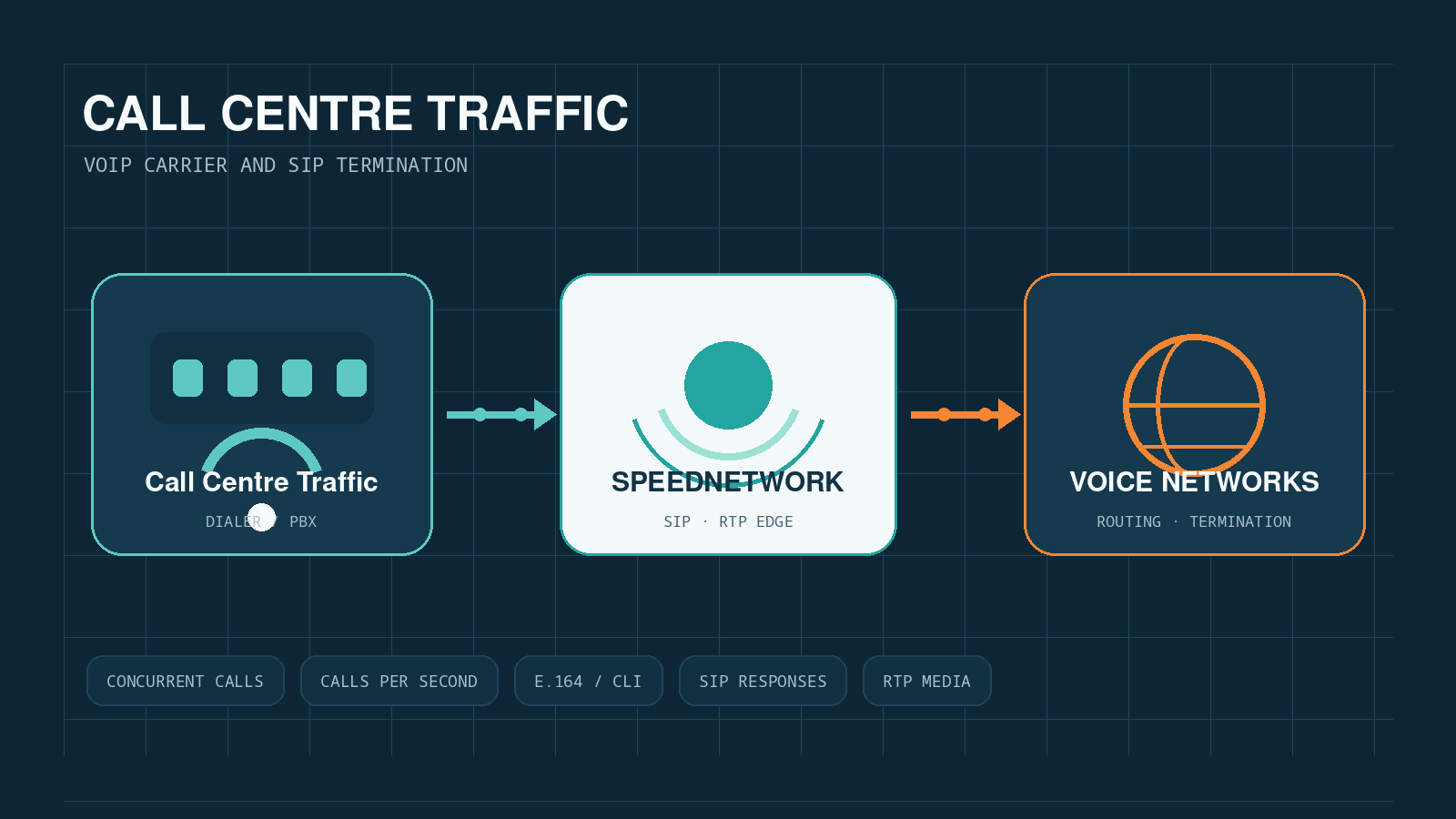
Predictive
Defined in the service profile
Progressive
Defined in the service profile
Preview
Defined in the service profile
SIP carrier
Defined in the service profile
01 · TECHNOLOGY AND OPERATIONS
Call centre traffic is not an ordinary office connection
Traditional office telephony is often sized around users and concurrent conversations. A dialler starts attempts automatically, evaluates outcomes and can adjust its pacing continuously. This changes signalling behaviour and the need for connections available at short notice.
We therefore ask about campaign type, dialling mode, daily load, destinations, average call duration and expected peaks. These inputs are more meaningful than agent count alone. Personal lead content is not required for an initial technical review.
02 · TECHNOLOGY AND OPERATIONS
Understand predictive, progressive and preview dialling
Preview dialling generally starts a call after an agent has selected the contact. Progressive dialling links the next attempt to an available seat. Predictive dialling forecasts availability and can create several attempts in parallel. The exact behaviour depends on your software and campaign configuration.
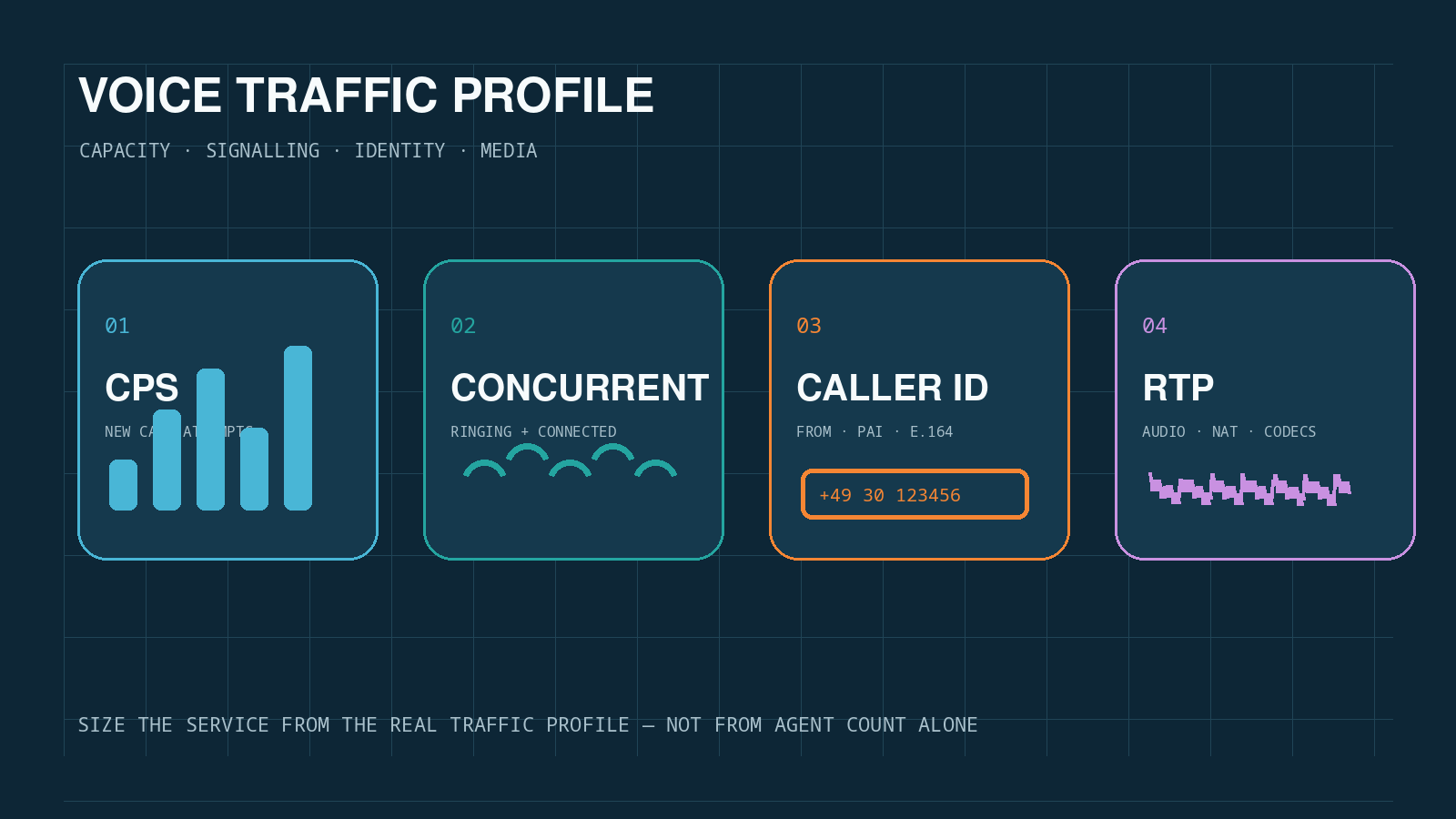
For the carrier, the important questions are how many new SIP dialogues begin per second and how many connections are ringing or connected at once. A seemingly small team can create a demanding load profile, while a large manually dialling team can be technically much quieter.
03 · TECHNOLOGY AND OPERATIONS
Describe destinations and routing in advance
German fixed, mobile, European and international destinations are not interchangeable. Destination mix, time of day and volume influence routing and commercial terms. New countries or materially different volumes should be reviewed before the change goes live.
A second carrier can support comparison, migration or a defined fallback path. Routing in the dialler or SBC must remain unambiguous. Uncontrolled retries across multiple routes can distort results and complicate troubleshooting.
04 · TECHNOLOGY AND OPERATIONS
Authorised caller ID rather than arbitrary presentation
Caller IDs are checked against the right to use them and the intended callback path. From and P-Asserted-Identity are handled according to the agreed connection parameters. A visible number must not be mistaken for permission to spoof arbitrary identities.
Where campaigns use different numbers, format, selection and assignment are documented. This makes it possible to distinguish a technical fault from an unauthorised or incorrectly formatted caller ID.
05 · TECHNOLOGY AND OPERATIONS
Test quality with specific call examples
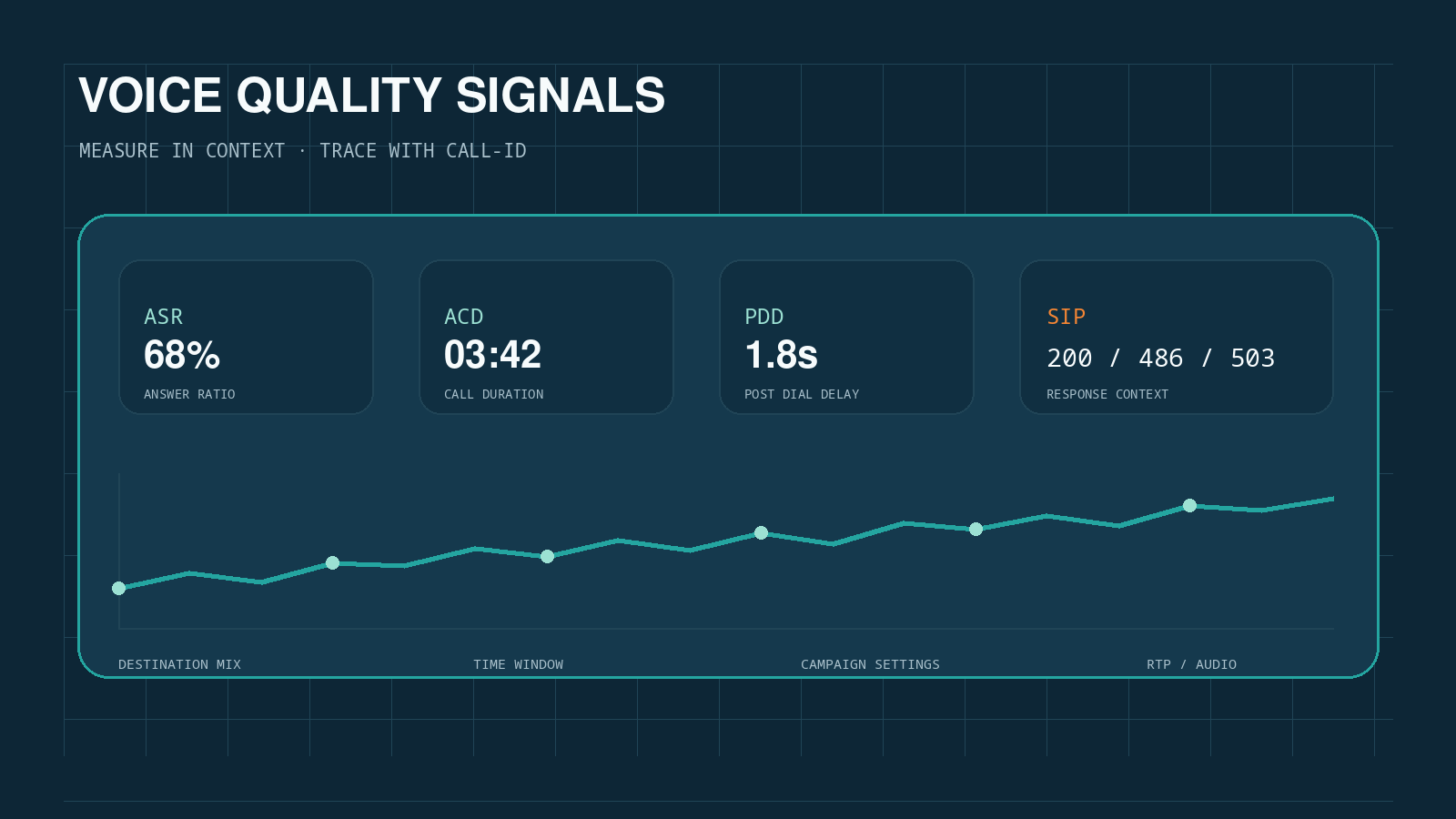
ASR, ACD and PDD provide useful signals but do not replace case-level analysis. For a technical issue, timestamp, time zone, destination, SIP Call-ID and observed behaviour are especially useful. Audio and signalling are examined separately.
A pilot covers more than successful conversations. Busy, no answer, early media, DTMF, clean hangup and, where required, callback paths also belong in acceptance. Production load is enabled in a controlled manner after a bounded test.
06 · TECHNOLOGY AND OPERATIONS
PoPs in Frankfurt and Berlin
SpeedNetwork presents technical handover points in Frankfurt at the Telehouse location associated with DE-CIX and in Berlin at the Level 3 location associated with BCIX. Depending on the project, connectivity can use the public internet, approved IP paths or separately agreed interconnection options.
The locations do not constitute a generic SLA or a statement that every customer automatically has a private circuit. Redundancy, preferred PoP and failover behaviour are agreed and tested in the service design.
TRAFFIC PROFILE
VoIP provider for call centre traffic: traffic profile and operational limits.
A VoIP provider for call centre traffic is not defined by one channel value. Destination mix, calls per second, concurrent ringing and connected calls, call duration and daily load interact. Before the pilot, we therefore document the permitted load, how the dialler limits it and which changes require a fresh review.
To keep the VoIP provider for call centre traffic traceable in production, test windows, number format, routing and technical contacts are recorded. A controlled ramp-up gives better evidence than starting immediately at maximum load. When results differ, specific Call-IDs and timestamps are more useful than broad assumptions about quality.
QUALITY IN CONTEXT
Read the metrics correctly and test specific calls.
Quality for a VoIP provider for call centre traffic is not inferred from one percentage. ASR, ACD and PDD depend on destination, campaign, contactability and time of day, among other factors. The figures are considered together with SIP responses and the actual media path.
For a specific fault, we check call setup, early media, two-way audio, DTMF and hangup. This distinguishes platform, network, signalling, RTP and destination issues. The approach makes the VoIP provider for call centre traffic technically testable and keeps responsibilities clear.
INFORMATION FOR A QUOTE
So sizing is based on facts, not guesswork.
A reliable VoIP provider for call centre traffic offer starts with aggregate technical and commercial information. Please do not send passwords or personal lead lists.
FAQ
Common questions about VoIP provider for call centre traffic before technical review.
Can I keep my existing dialler?
Yes. The VoIP service can be evaluated independently of a platform change. VICIdial, OSDial, Asterisk, FreePBX and other SIP-capable systems are reviewed using their actual connection parameters.
What information belongs in an enquiry?
Useful inputs include destinations, expected minutes, peaks, concurrent calls, CPS, dialling mode, platform version and target start date.
Do I need to send lead lists?
No. Aggregate traffic and system data are sufficient for an initial carrier review. Credentials and personal lead lists do not belong in the contact form.
Technical reference: Further primary source.
THE NEXT STEP
Review your call centre traffic
Describe the dialler, destinations, volume, CPS and concurrent calls. We will respond with the right next questions.